
Hello there, geography teachers!
I hope you are all doing well. I just finished my newest activity, the Diffusion Lab. This one is a little different from my last one, the Population Pyramid Lab. Here, students earn badges as they work through a set of activities that practice the diffusion topics in the CED.
Students start by identifying the types of diffusion, then look at how diffusion happened throughout history, move on to contemporary causes, practice how diffusion affects society and culture, and wrap it all up with some good old FRQ practice.
Before you jump in, I want to highlight a couple of things. First, check out the For Teachers tab at the top of the page.
There you can create a custom assignment where you choose which activities your students will do and how many cases are in each one. This lets you fit the activity to the amount of class time you have.
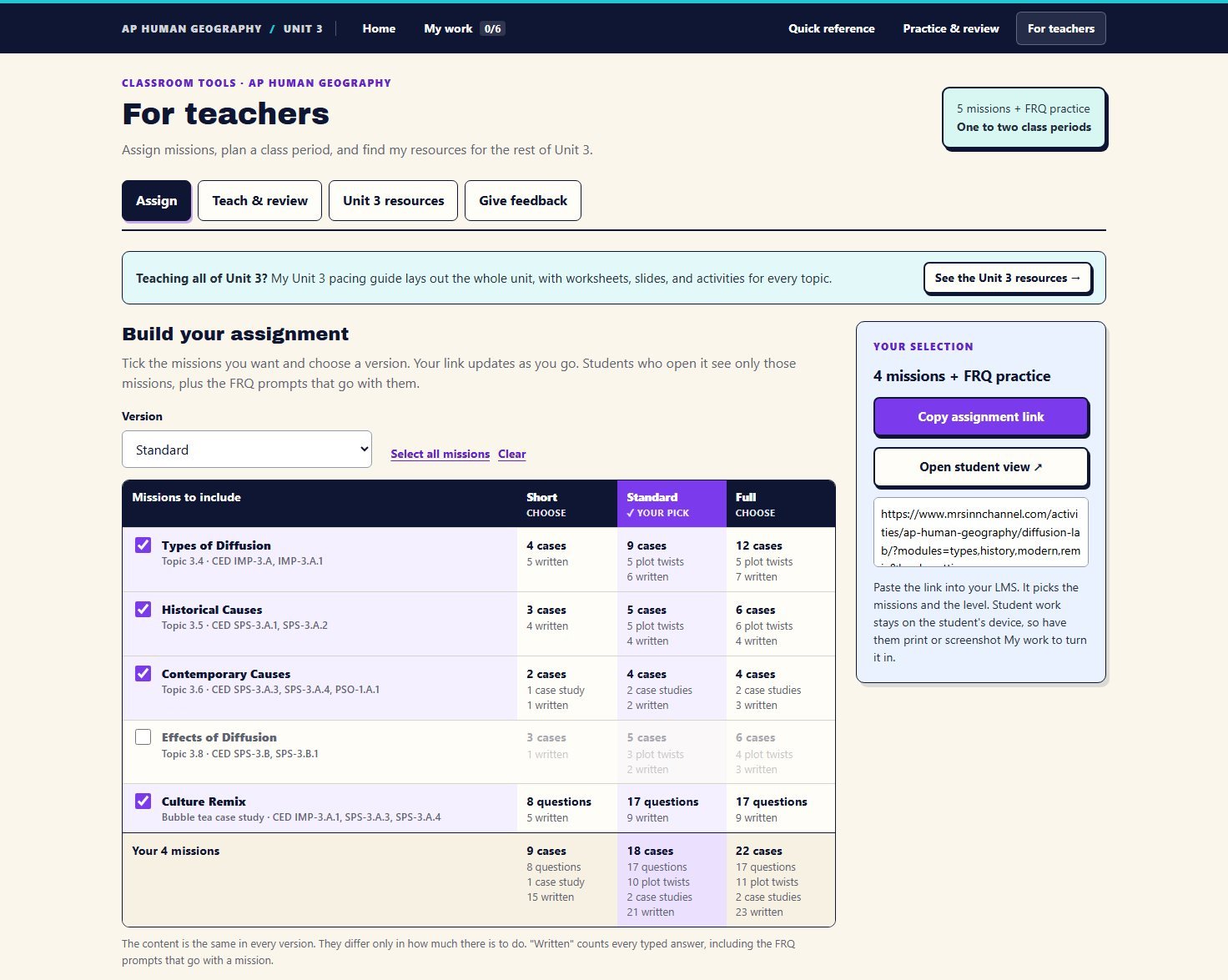
Once you build your assignment, share the link with your students, and they will only see what you selected. When students finish, they can go to the My Work section and print their answers and badges to show they completed the assignment, then turn that in to you. (Note: The printout can also be saved as a PDF and turned in on your LMS.)
What is the activity?
Alright, so what is this activity? Well, it is made up of 6 missions. Each one has its own cases, interactive elements, and FRQ practice.
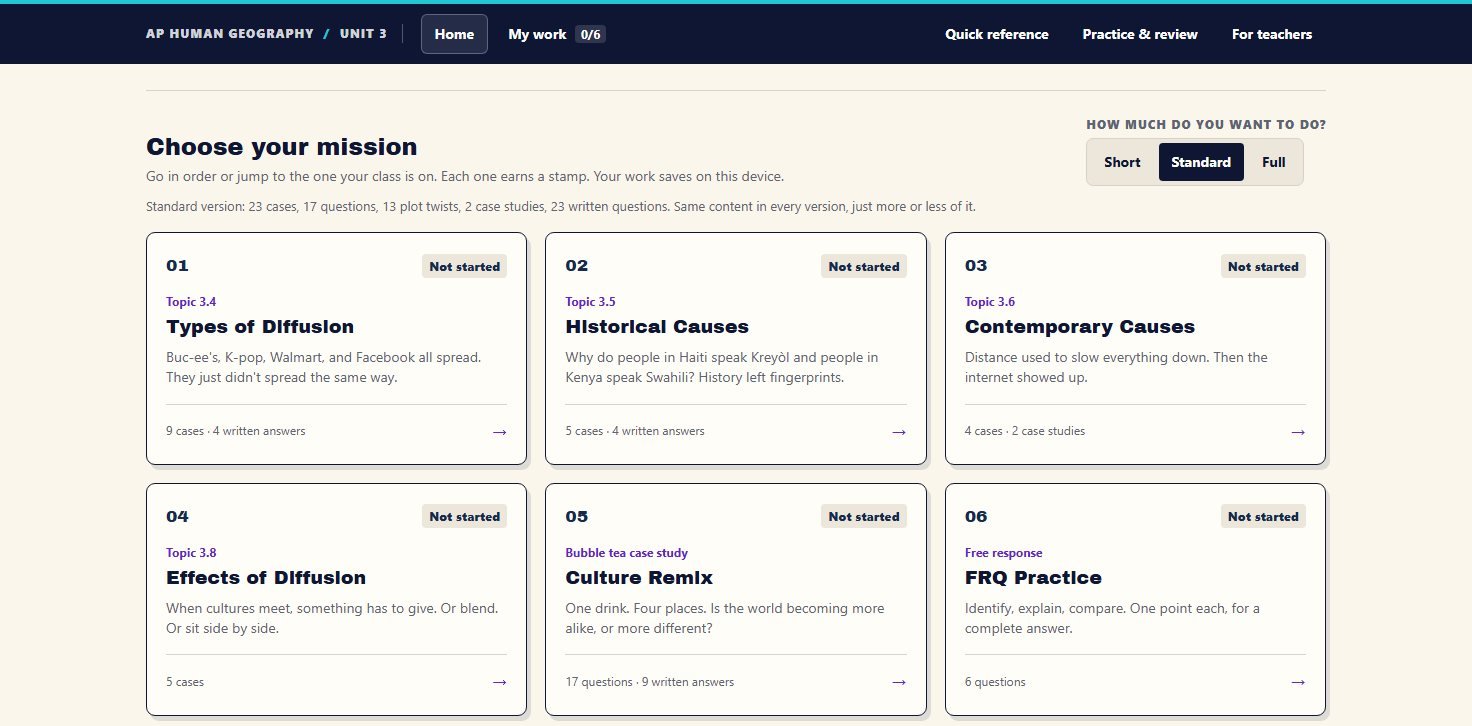
Types of Diffusion has students use a map to follow the spread of Buc-ee’s to understand diffusion. Then they move to case files on different topics, where they identify the type of diffusion being shown.
Historical Causes has students look at case files from the past and identify which historical cause led to the diffusion. After that, they shift to the write-up section, where they practice short FRQs focused on historical causes of diffusion.
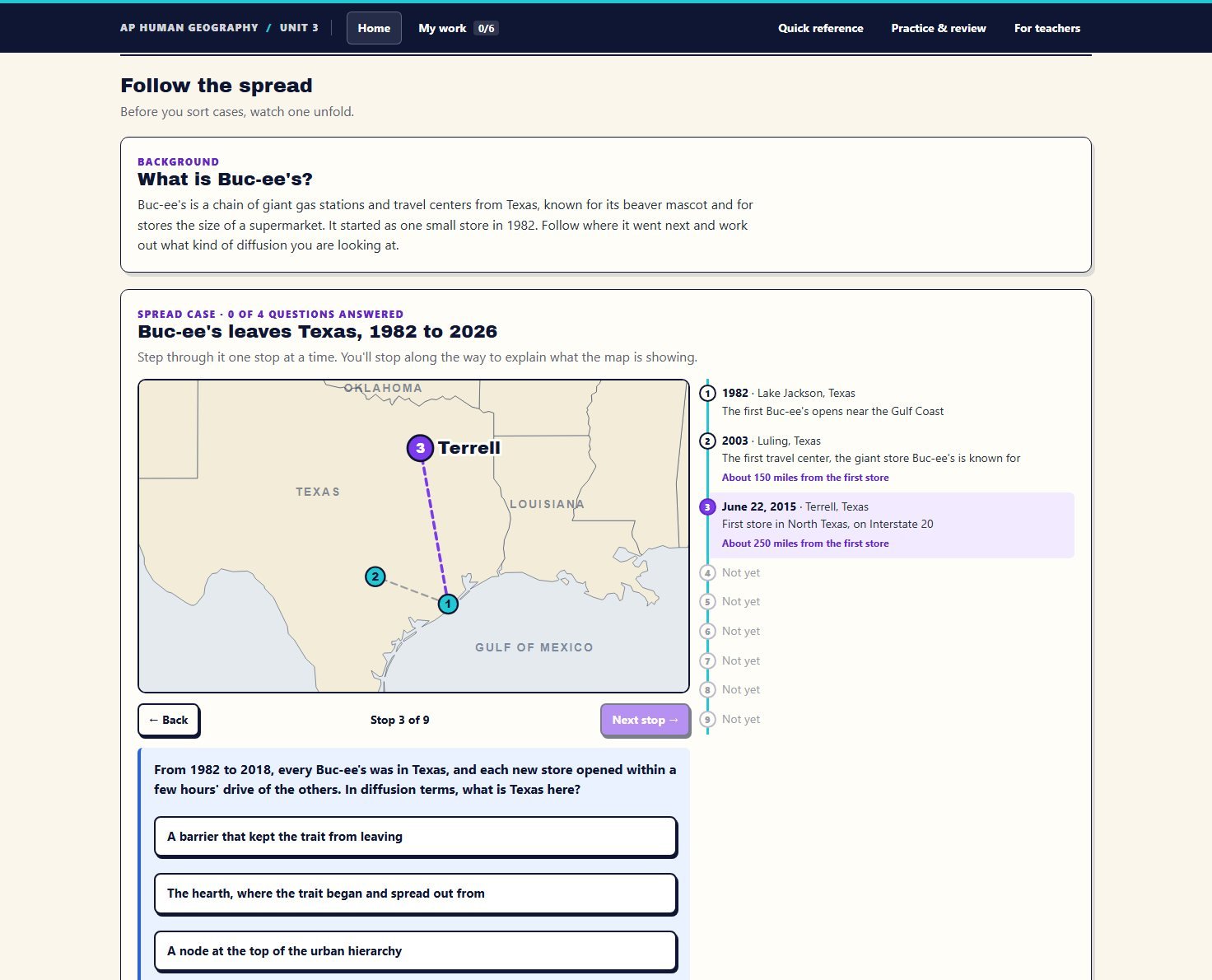
Contemporary Causes starts with a quick matching game, where students connect class vocab to modern diffusion cases. After that, students go to the diffusion simulator to see how different types of diffusion spread information. Lastly, students review two modern cases where they look at evidence of diffusion, identify the class concept being shown, and then write FRQ-style responses explaining their reasoning and the geographic concepts.
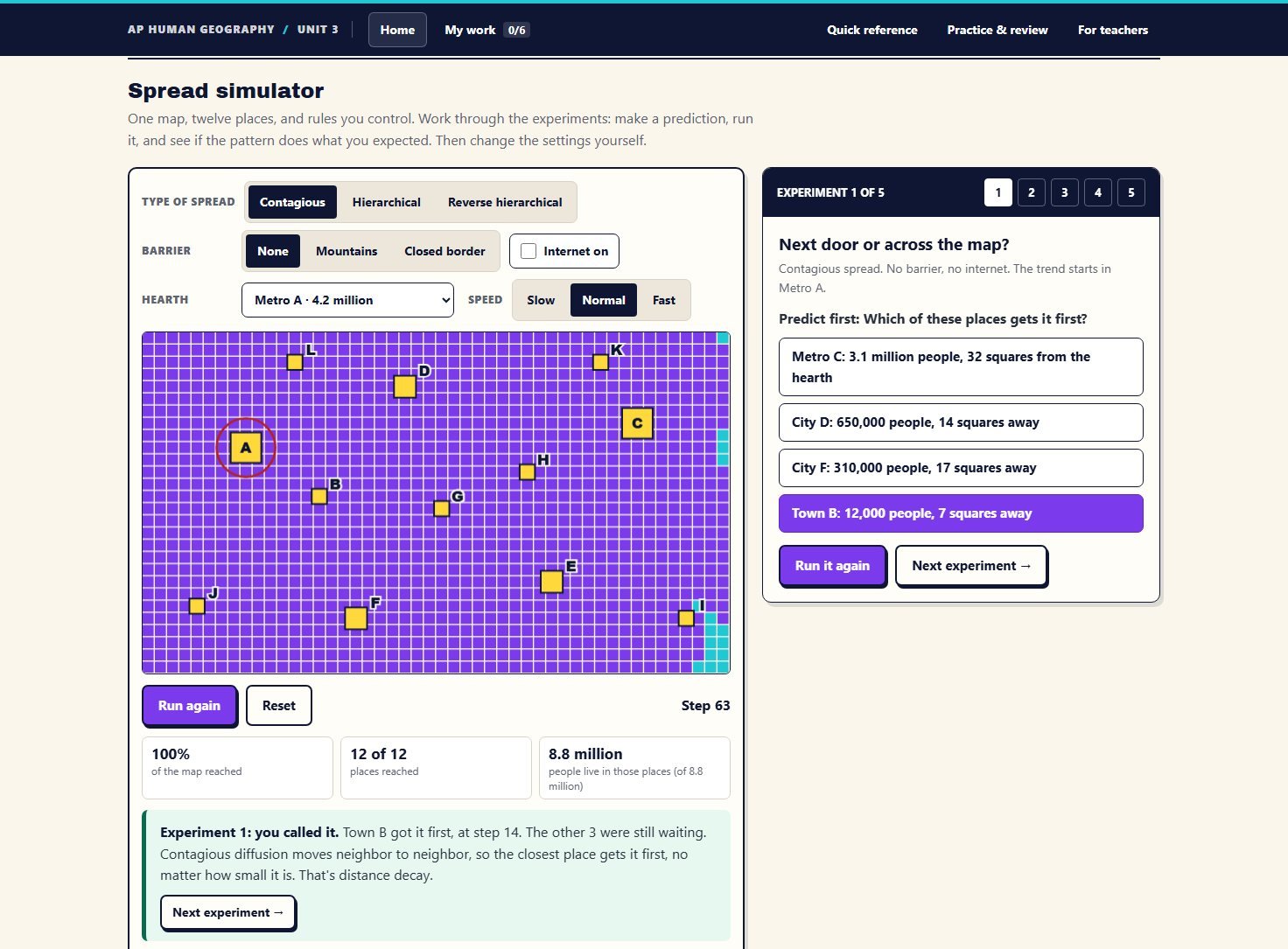
Effects of Diffusion has students look at real-world events, identify the effect of diffusion, describe how diffusion is affecting society, and finally explain the geographic concept.
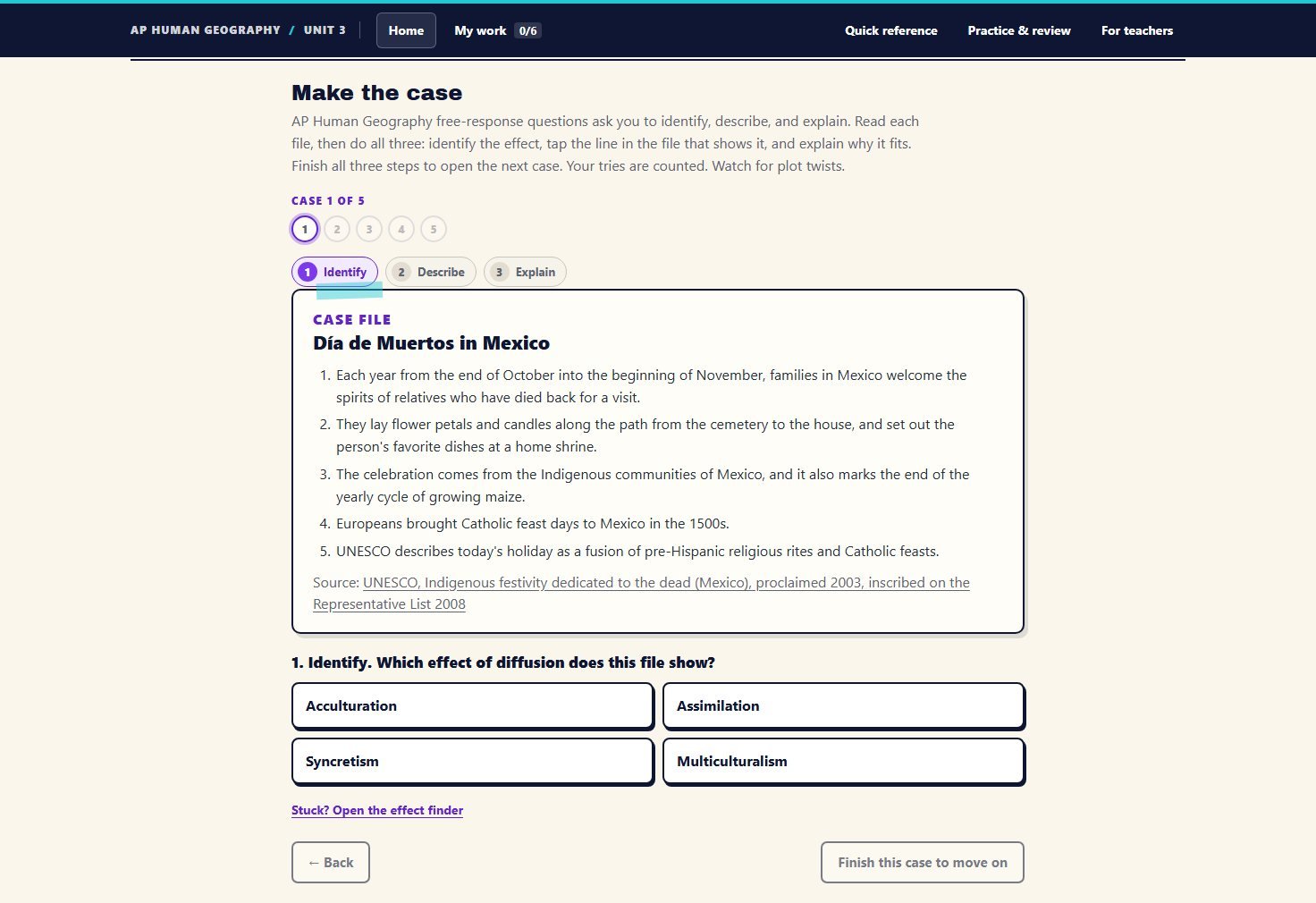
Culture Remix starts with students looking at photos of bubble tea and answering questions about the photos and diffusion. After that, they look at a map showing how bubble tea spread. Lastly, they answer questions on cultural convergence and divergence and practice scale of analysis.
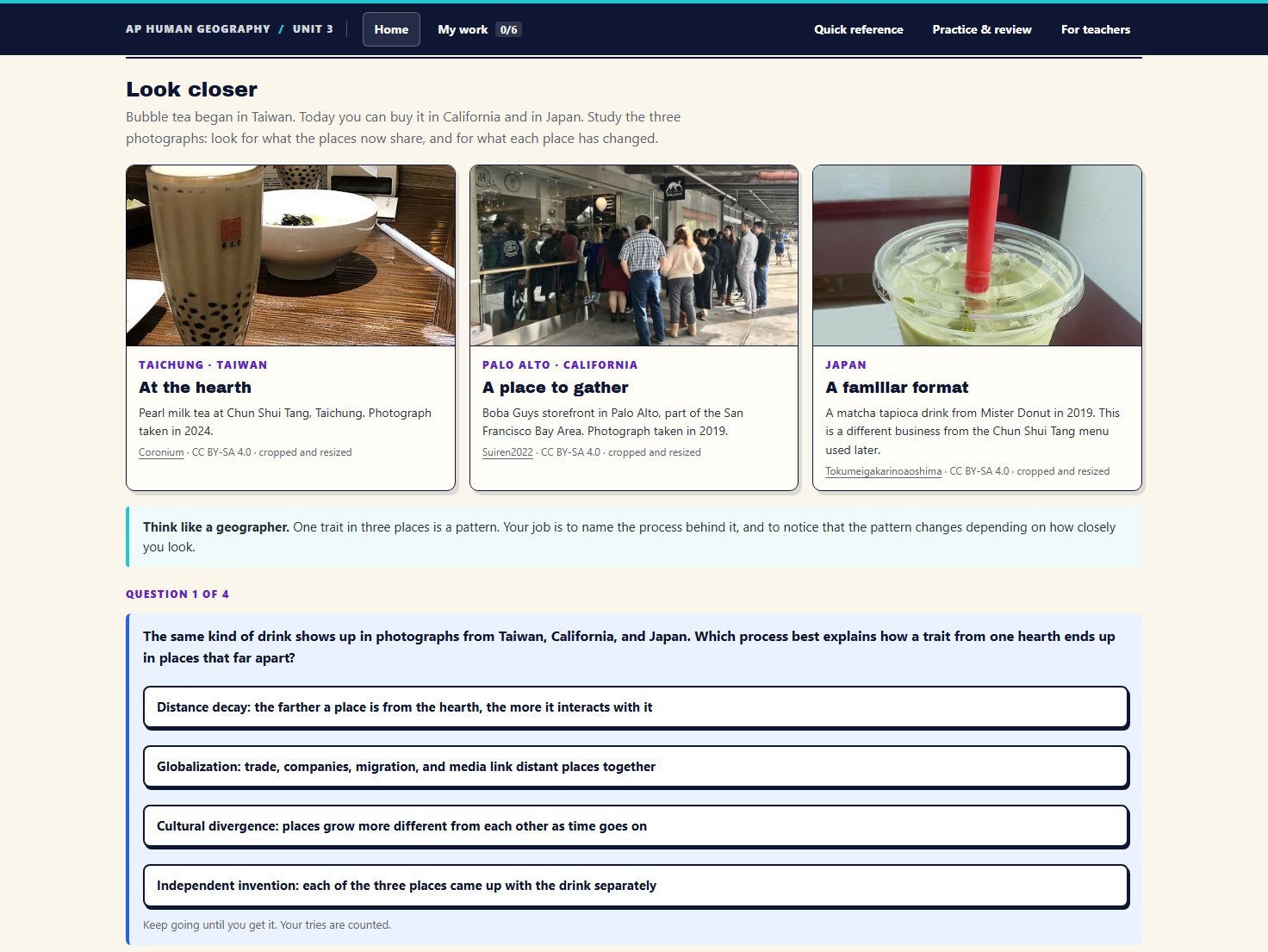
FRQ Practice has students answer FRQ-style questions on the concepts they worked on in the earlier missions. This gives them more writing practice, and they can self-grade each answer once they have answered the question.
One quick note: Student answers are saved locally on the device they are using. If students switch devices, their previous answers will not transfer, so it is best to have them stick with one device.
Grading
Speaking of grading! Just like in my past activities, students can check their work and grade their answers as they move through the activity.
If students want to review their answers as they go, they must attempt all the questions for that section first.
The goal of this is to get students to try and answer the short answer questions first, before looking at the answer.
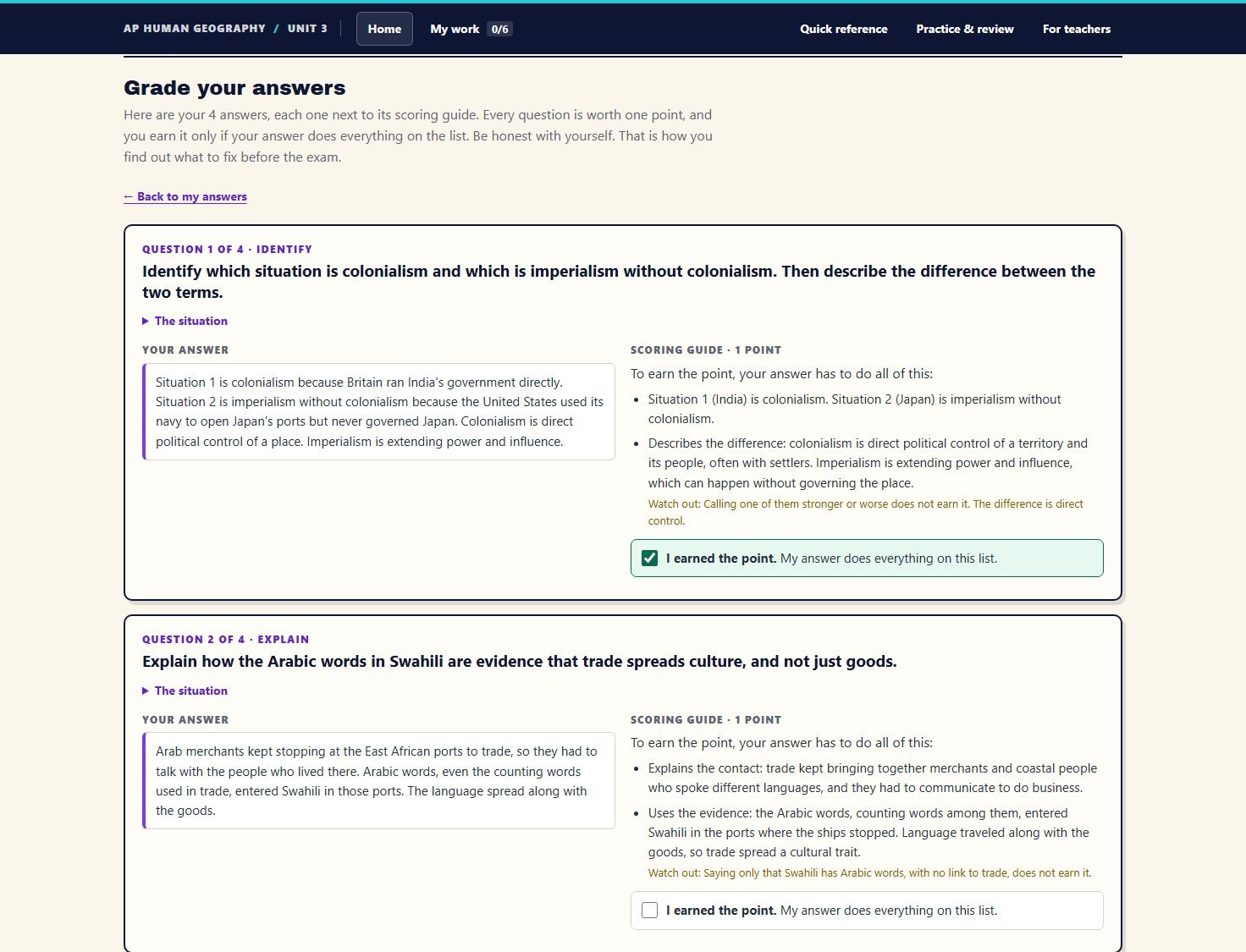
Once students grade their work, they can save their results as a PDF or print them, which makes it easy to turn in their work or show you they completed the assigned missions.
How I would use this in my classroom
When teaching diffusion, I normally start with a lecture on the types of diffusion (see my Topic 3.4 Google Slides presentation). During the lecture, I make sure students understand the different types of diffusion, how things spread out from a hearth, and how diffusion occurs.
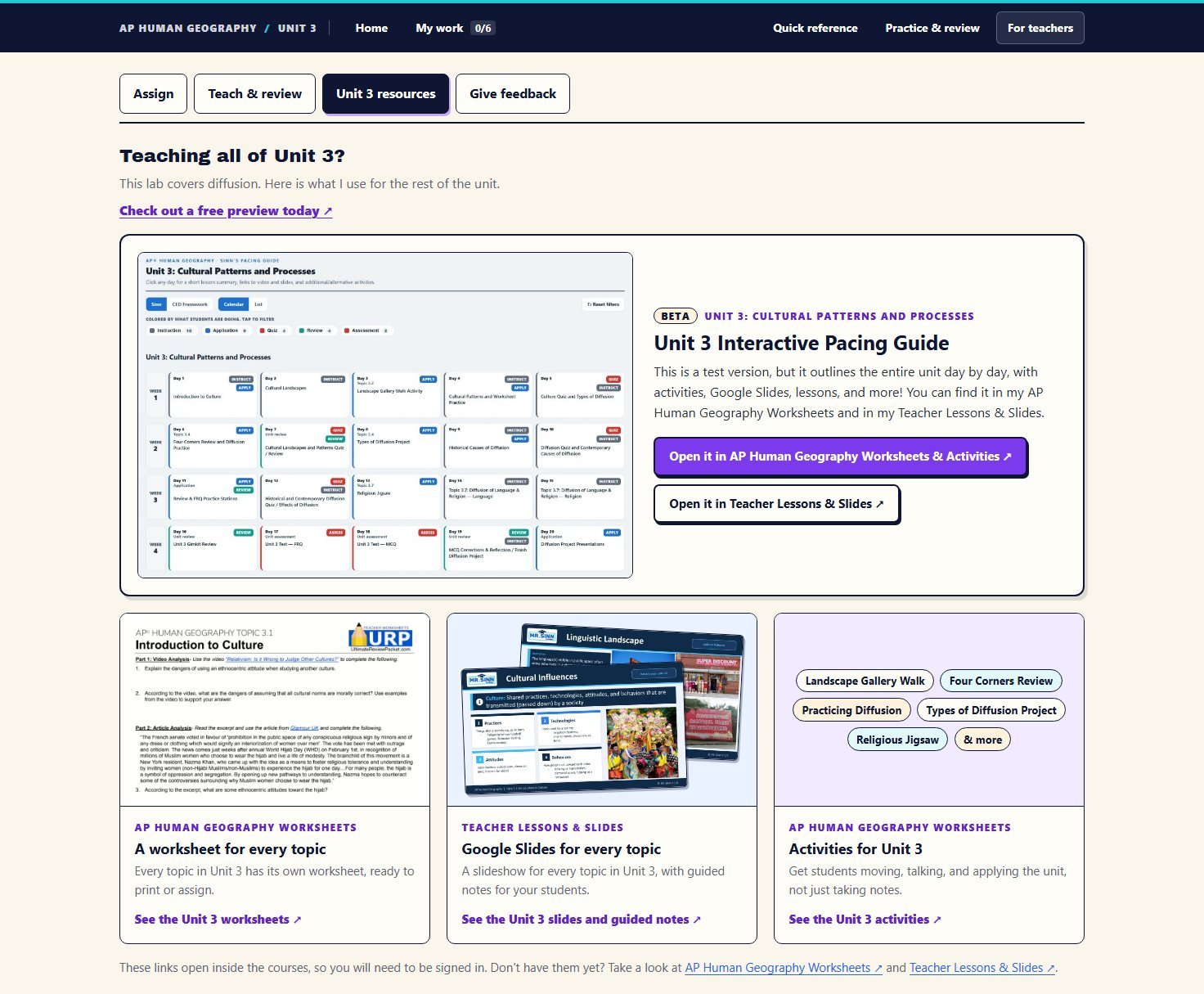
After our overview, I have students practice right away. In the past, I have used activities like my Topic 3.4 worksheet, Four Corners Review, or Practicing Diffusion (see my activities and worksheets). Now I would also use an activity like this one!
When I built it, I set it up to start with the basics, having students identify the types. From there, each activity keeps building, adding more CED terms, more topics, and more complexity.
So after reviewing diffusion as a class, I would move into the Diffusion Lab.
I personally like having students work in pairs. This gives each student someone to bounce ideas off of, discuss patterns with, and lean on if they get stuck.
You could absolutely have students work individually or in larger groups. However, I often find that when groups get too large, students are more likely to get distracted, and fewer students end up doing the actual work.
Once students start working, I like to walk around the room and check in with different groups. Generally, I try to:
- Help groups that are struggling
- Ask follow-up questions instead of immediately giving answers
- Push students to explain what they are seeing in the maps and case files
- Give extra discussion questions to groups that are moving quickly
My goal is to make sure every student is learning and getting the support they need.
Feedback and future projects
If you have time, I would love to hear your feedback on the activity.
Your feedback helps me understand what is working, what could be improved, and how I can make future activities more useful for both students and teachers.
Also, if you have an idea for a future AP Human Geography activity, feel free to send it my way!
Well, I think that is it!
Go check out the Diffusion Lab and see if it works for you and your classroom.
Thank you for your time and for everything you do for your students. I hope your school year is off to a great start!
Mr. Sinn
Help me make the next one better
Any feedback you can give me helps me understand how to improve for the future!
Get the next one
I’ll email you when a new post goes up — that is the only thing this list is used for.